
You know your team’s routine. Top to bottom, shift after shift, everything done by the book. Everything looks great, there’s nothing worth flagging.
And still, the smell near the drain at the end of a shift. The complaint about the locker room. The failed audit doesn't reflect how hard your team actually works.
The instinct is to question the team. Retrain. Add a step. But what if the protocol itself, followed correctly every shift, is what's allowing contamination to persist? Not because anyone is cutting corners, but because some standard cleaning methods don't just fail to eliminate pathogens. They spread it.
That gap between a protocol that looks right and a facility that's actually clean shows up in hotel kitchens and restaurant prep areas, in gym locker rooms and spa treatment spaces, in school cafeterias and healthcare environments. The settings are different. The mechanism is the same. And it starts with a distinction that most protocols blur.
The distinction matters more than most routines acknowledge. The CDC draws a clear line: cleaning removes contaminants from surfaces but doesn't necessarily kill them. Disinfecting does. But only when the chemistry stays in contact long enough, covers the right surfaces, and gets applied the same way every shift. When any one of those conditions isn't met, the protocol passes. But the facility isn’t really clean.
Here's where that happens.
Where Sanitation Gaps Shows Up in Your Facility.
Following a clean-to-dirty, top-to-bottom routine is often a good start. First introduced in medical environments, the method still applies in foodservice. Teams begin in lower-risk areas, like prep tables and counters, then move toward higher-risk spaces like drains or bathrooms. The goal is simple: avoid contaminating surfaces that have already been cleaned.
However, this approach makes two major assumptions that most of us were never taught to examine:
- What goes down the drain stays in the drain.
- What gets applied to a surface stays on it long enough to work.
Let's take a look at a few of the specific zones that often fall victim to these dangerous assumptions.
Drains and Floor Surfaces.
In many facilities, drains are treated as just another cleaning target. Pour some product down, rinse the area, and then move on. Here the drain is simply part of the floor, and the floor gets cleaned last.
The problem is that drains aren't just a destination for contamination. They're a source.
No matter what type of drain your facility uses, they all share a few common traits: a drain body, a p-trap, and more crevices than you can count. Over time, those surfaces begin to support the main enemy of sanitation:
Biofilm.
Biofilm is invisible to the naked eye, but once enough of it builds up or matures, a slimy substance ranging in colors becomes visible. Bacteria hiding inside biofilm can survive even after cleaning and disinfecting. In some cases, it can be up to 1,000 times harder to kill than normal surface bacteria. Research has also found that drains can keep bringing contamination back into a space, even after the area looks clean.
A hotel kitchen drain, school cafeteria drain, or gym locker room drain can all create the same problem.
Some drain cleaning solutions can make matters even worse.
Cleaning with high-pressure spray means when you blast a drain, the water and chemistry can aerosolize bacteria on impact. This creates a fine mist that carries contamination from the drain onto surrounding floors, walls, and equipment. Even the water pressure from a sink faucet has been found to carry pathogens out of a drain and into the surrounding room, through these tiny water droplets.
The zone may look treated. The proper steps may have been followed. But what’s really happening is redistribution.
All your hard work down (or should we say out of) the drain.
High-Traffic Surfaces and Contact Points.
The busiest areas often become the hardest places to keep consistently clean.
Spaces like gyms, locker rooms, spas, and shared equipment are constantly being used by different people throughout the day. That constant traffic gives teams less time to properly clean between uses, which makes these areas more vulnerable to sanitation gaps.
The main issue here is dwell time. In other words, your chemistry does not have enough time to properly interact with the surface it was intended to clean.
Most commercial disinfectants include contact time requirements, and EPA guidance is direct: a surface must remain visibly wet for the full contact time listed on the label.
But let’s be honest.
When a team member has to move through a cleaning rotation quickly, it can be hard to let chemistry sit long enough to do its job, let alone confirm the entire surface was properly covered.
30 seconds of exposure is significantly less effective than a full minute of contact time on hard surfaces. This gap presents a real risk in fast-moving cleaning environments.
Now onto the surface coverage problem.
Spray works well on open, flat surfaces. But most facilities aren’t solely made up of countertops. Vertical walls, grout lines, textured flooring, equipment edges, corners, you name it, are all places where chemistry can run off, miss spots, or become difficult to see altogether.
When teams are moving quickly, that visibility problem matters even more. If you can’t clearly see where chemistry landed, you either waste time and product spraying over the same spot or miss a section altogether.
A sanitation gap in a locker room might go unnoticed for a time. Now a sanitation gap in a food prep environment, that can follow someone straight to their table.
Kitchens, Wet Areas, and Back-of-House.
Foodservice environments often follow a set cleaning process. Each step takes time, and in a busy kitchen or cafeteria it becomes easy for steps to get rushed, skipped, or done out of order.
And even when teams follow the process exactly as trained, the program itself could still let them down.
It’s not negligence. It's a design problem.
In kitchens or cafeterias, cleaning requires workers to constantly switch between tools, chemicals, and tasks. One product for cleaning. Another for sanitizing. Different cloths, brushes, mop heads, or applicators for different areas. When equipment is awkward to move, difficult to set up, or frustrating to switch between, it becomes easier for steps to get skipped or completed out of order just to keep up with the demands of the shift.
And sometimes the tools themselves create new problems.
A rag, mop head, brush, or cleaning pad can spread bacteria from one surface to another if it is reused incorrectly or not changed often enough.
Now you’re being forced to perform a balancing act.
Systems that rely on too many separate tools and steps can become difficult to repeat consistently from shift to shift and team member to team member.
But simpler tools may make cross-contamination easier.
That’s why with most sanitation programs, “clean” is not just about effort. It depends on whether chemistry reaches the surface properly, stays there long enough to work, and gets applied consistently from one shift to the next.
Now, we wouldn’t spend this much time talking about the problem if we didn’t believe there was a better way to approach it.
What “Actually Clean” Requires.
Getting the most out of your cleaning chemistry comes down to three things: making sure it reaches the surface properly, stays there long enough to work, and gets applied consistently from one shift to the next.
In busy facilities, those three things can break down fast, making it harder to keep surfaces consistently clean across the facility.
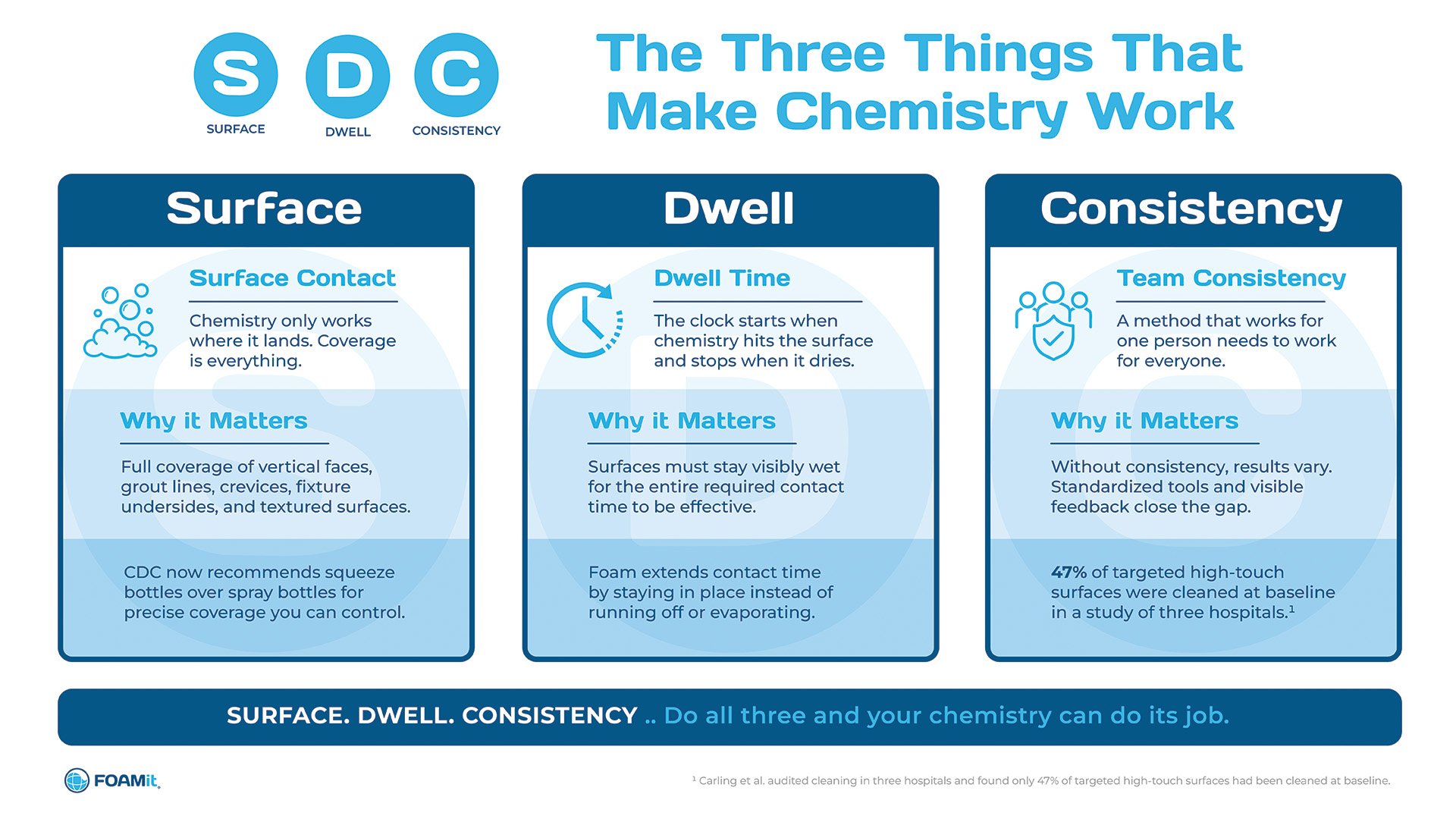
Let’s start with surface contact. Chemistry only works where it lands. Properly covering vertical surfaces, small crevices, and fixture undersides can be a real pain in your underside.
Foam changes that.
Traditional spray systems are designed to apply chemistry quickly.
Foam cleaners and foam application systems are designed to keep chemistry in place long enough to work across difficult surfaces and hard-to-reach areas.
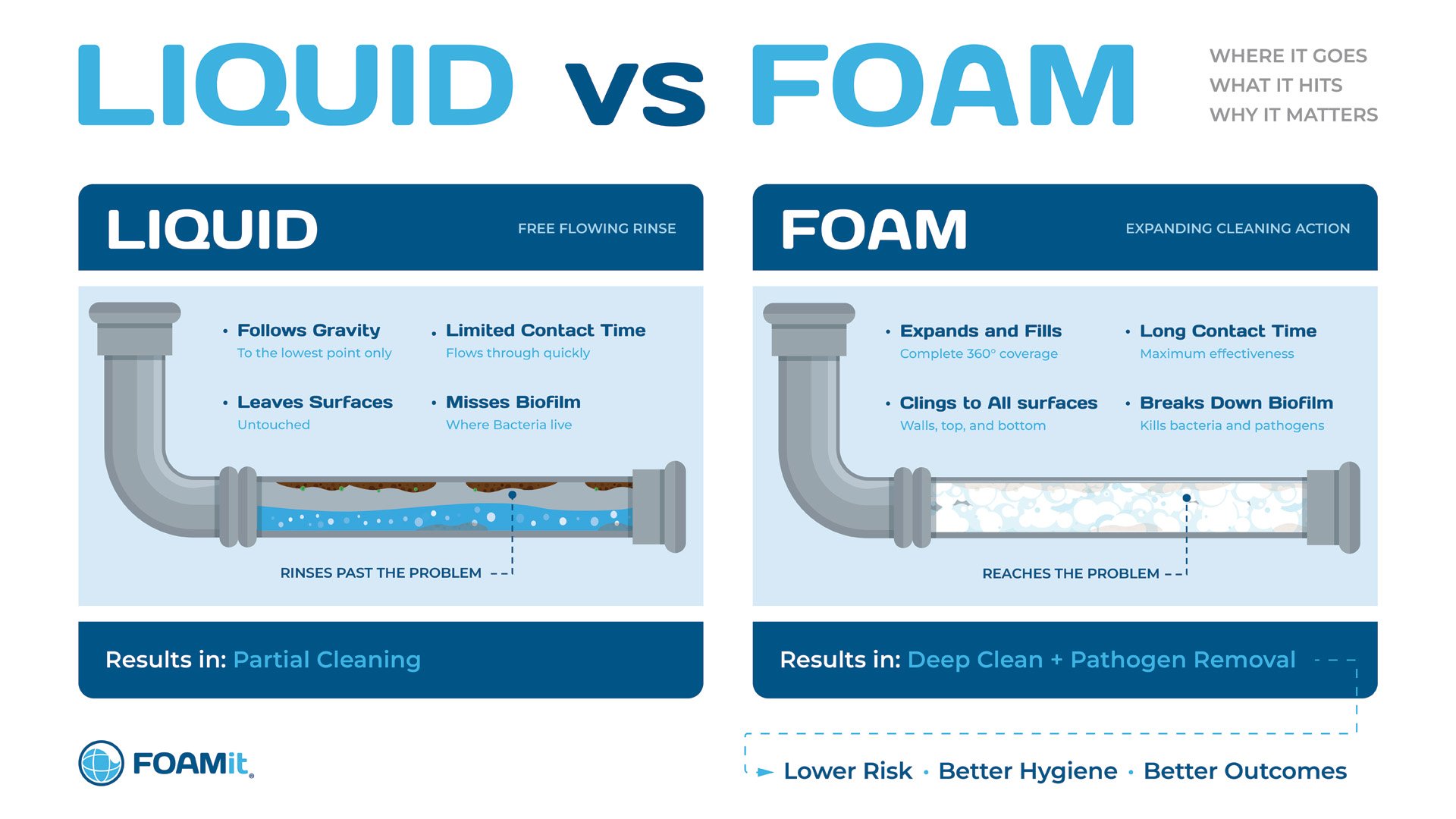
Instead of blasting, it fills. It coats the inside of drains, pipe walls, and surrounding surfaces. With 360-degree coverage, your chemistry actually clings in place long enough to work.
Instead of aerosolizing unwanted germs into the space around it, foam actually traps the pathogens.
A quick rinse may wash away some bacteria, but it doesn’t eliminate enough biofilm to give you time before it starts to grow back again.
That often leads to the same drains and problem areas needing attention over and over again.
Odors return. Build-up comes back. Teams clean the same zones shift after shift without ever fully solving the source of the problem.
Better surface coverage helps break that cycle.
Foam also offers the added benefit of clear visibility. If you never hit a surface, you can forget about contact time. Once solution is applied, it becomes very clear what areas have not been reached.
That visibility changes how teams clean.
Instead of guessing whether a surface was fully covered, employees can see it immediately. Missed spots become easier to catch before the process moves on.
Managers can also verify coverage more easily during walkthroughs or audits. The process becomes less about memory and more about what can actually be seen.
Now, dwell time.
Getting full surface coverage is only half the battle. Once chemistry makes contact, an invisible clock starts. It stops the moment your solution runs off or dries up.
In humid bathrooms or warm kitchens, that runoff can happen quicker than you expect.
On the other hand, chemistry can be applied too thin. It can also get wiped away too soon. When either of those things happen, the chemistry may not stay on the surface long enough to fully work.
For the most effective sanitation results, the surface must stay visibly wet for the required contact time.
Foam extends this cleaning window.
The bubbles in foam help it latch onto its target, extending your dwell time. Product running off a surface is no longer an issue.
A thick layer of foam can help trap your active ingredient. This significantly slows down evaporation.
Surface contact and dwell time are important. But they only matter if the process can be repeated consistently across the entire team.
That’s where many sanitation programs start to break down.
One employee may follow every step perfectly. Another may rush through part of the process without realizing it. A veteran employee may get it right every time. A new hire is having to juggle where chemicals go, which tools to use, or what order the process happens in.
That kind of variability is human. Especially in fast-moving environments with multiple shifts and rotating staff.
And the more a program depends on perfect habits or experienced employees, the harder it becomes to repeat consistently across the whole facility. It becomes more likely to change from person to person.
Simpler workflows are easier to repeat.
Teams spend less time switching tools, changing chemicals, or trying to remember what step comes next. That matters in facilities with multiple shifts, rotating staff, or employees with different experience levels.
The less guesswork built into the process, the more consistent the results usually become.
That’s why cleaning equipment design matters. When the process is built directly into the equipment, there’s less room to skip a step or do things out of order. With one unit, one hose, and a simple switch between functions, it becomes easier to do the process correctly than to change it up.
Where to Go From Here.
Sanitation gaps happen. For most facilities, the cleaning steps are right, the effort is real, and the team is following through. What doesn't get examined often enough is whether the method those steps rely on is actually capable of delivering the outcome.
Surface contact. Dwell time. Consistency across every person on the team, every shift. When all three are met, the gap closes. When any one of them isn't (and with spray application, pressure equipment, and time-pressured rotations, at least one usually isn't) the protocol passes and the contamination stays.
That's the gap between clean and actually clean. And it's almost always a method problem, not a people problem.
Start by looking at the commercial cleaning equipment your team uses every day. Spray bottles, mops, and pressure-based cleaning systems may work well for some tasks, but in large-area or room-by-room sanitation they can also limit how well chemistry reaches the surface, how long it stays there, and how consistently it gets applied from person to person.
And yes, we’re going to bring up drains again.
Floor drains in kitchens. Locker room drains. Pool area drains. Sink drains. These areas often get treated like a quick finishing step instead of a major sanitation risk. But ask yourself: how deep is the clean actually going? Are drains being fully taken apart and cleaned regularly? Are traps, lips, crevices, and pipe walls being reached? Or is chemistry mostly getting poured down and rinsed away?
There is no such thing as a perfect sanitation program, but there are consistent ones. The goal is a program that performs the same way whether your most experienced employee is running it or the newest person on the team is.
Because in most facilities, the protocol may be getting followed correctly. That doesn’t always mean the facility is actually getting clean.
The difference usually comes down to whether the method is up to the real world conditions and can be repeated consistently day after day.