
Most sanitation programs have a blind spot. It is not the product they are using or how often they are cleaning. It is whether the chemistry is actually getting enough time to do its job. That gap has a name, contact time, and it is the most forgotten rule in sanitation.
Most people working in hospitality and food service are not cutting corners on purpose. They are moving fast because the job demands it. So the disinfectant or sanitizer goes on, the cloth comes right back, and everyone moves on assuming the surface is clean.
Here is the thing. It might look clean. It might even smell clean. But if the product did not have enough time to do its job, the surface is not actually disinfected or sanitized. It is just wet. And then dry.
What is contact time (or dwell time)?
Contact time is exactly what it sounds like. It is the amount of time a disinfectant or sanitizer needs to stay wet on a surface in order to actually work. Not the time it takes to spray and wipe. The time the product needs to sit there, doing its job, before anything touches it again.
Every disinfectant and sanitizer has a contact time listed right on the label. Some products need 30 seconds. Others need 2 minutes. Some need as long as 10 minutes depending on what pathogen they are targeting. The number varies by product, so the best thing you can do is flip your bottle over and take a few minutes to read through the contact time recommendations on your chemical labels.
What happens if you wipe disinfectant off too soon?
The reason contact time matters comes down to basic chemistry. These products work by breaking down the cell walls of bacteria, viruses, and other pathogens. That process takes time. Pull the cloth too soon and you have interrupted the reaction before it finished. The surface looks clean. The chemistry did not complete its task.
Think of it like a dishwasher. You would not open the door halfway through the cycle and call the dishes done.
Why contact time fails in practice.
Here is the honest truth. Contact time is not a new concept. It is printed on every bottle of disinfectant or sanitizer in your supply room right now. So why are not more people talking about it?
But there is a gap between knowing the rule and actually following it in a fast-moving operation.
Sanitation teams in hotels, resorts, spas, and food service environments are moving fast. A housekeeper turning over rooms at peak checkout is not thinking about dwell time. A line cook wiping down a prep surface between tickets is not watching a clock. They were trained to cover the surface, and that is what they are doing. The motion is right. The timing is just off.
It is hard to blame anyone for that. Most workflows do not naturally pause for the disinfectant or sanitizer to finish its job. It is unlikely anyone built waiting into the process. So the spray goes on, the cloth comes back, and the cycle repeats hundreds of times a day across an entire property.
What's at stake for your guests.
So what happens when contact time gets cut short? The surface dries. The product stops working. And whatever was living on that surface before you sprayed it might still be living there after you wiped it.
That is not a scare tactic. It is just what the chemistry does when it does not get enough time. And in a hospitality environment where surfaces turn over constantly, the margin for error is smaller than most people realize.
In food service settings, norovirus is one of the biggest drivers of foodborne illness outbreaks. Restaurants account for nearly two thirds of all reported norovirus outbreaks from contaminated food, with catering and banquet facilities adding another significant chunk on top of that. If your property has a restaurant, a banquet space, or room service, that risk lives under your roof too.
The same is true at the surface level. When a product does not get its full contact time, the protection your team thinks they are providing simply does not exist.
Your team followed the steps and the room passed a visual inspection, but if the product did not have time to finish the job, the result is not what anyone thinks it is.
This is the gap between a clean-looking operation and one that actually is. And in an industry where one bad guest experience can travel fast, it is worth closing.
How foam helps maintain disinfectant contact time.
The good news is that solving for contact time does not mean slowing your team down. It means changing how the product gets applied, not how long your team spends in the room.
This is where foam comes in.
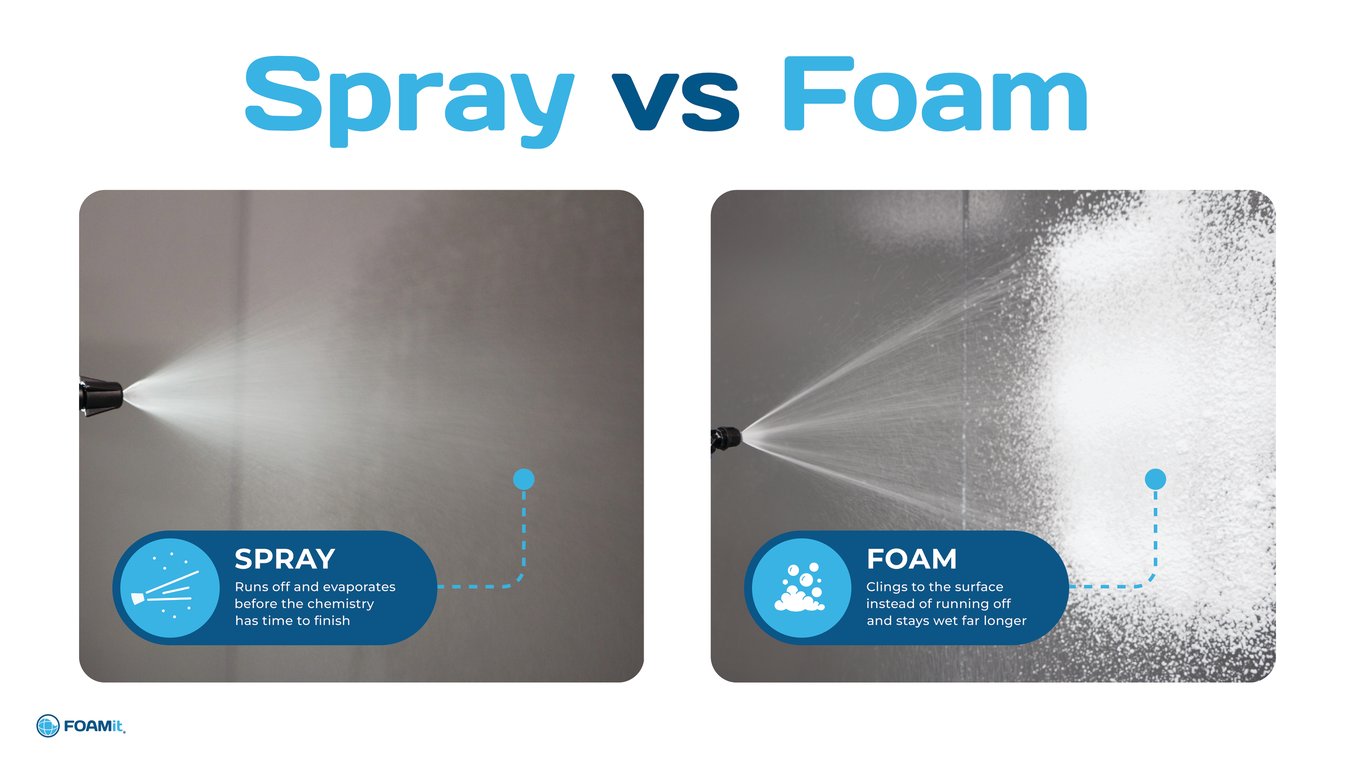
When you apply a disinfectant or sanitizer as a foam, two things happen that a liquid spray cannot deliver. The foam clings to the surface instead of running off, and it stays wet far longer instead of evaporating before the chemistry has time to finish. Those are two distinct problems that cut contact time short, and foam addresses both at once.
Foam maintains surface contact significantly longer than liquid alternatives, particularly on vertical surfaces, irregular surfaces, and hard to reach areas like drains and fixtures. Those happen to be exactly the kinds of surfaces that are easiest to wipe too soon and hardest to clean thoroughly.
Your chemistry and product remain the same. The only thing that changes is the application method. Just confirm that your chemistry is foam compatible before making the switch. Your FOAMit expert or chemical supplier can help verify that quickly.
The question is what that actually looks like when your team is in the middle of a full house.
What this looks like on your floor.
Foam gives your chemistry something a liquid spray cannot, time. While your team moves on to the next task, the foam stays put, clinging to the surface and keeping the product wet long enough to actually finish the job. A liquid spray evaporates before that window closes. Foam does not. When your team comes back, the surface is still wet, the chemistry has had time to work, and it is ready to be wiped down. Nobody has to stand there and watch it dry. Nobody has to set a timer. The work keeps moving because the chemistry is working too.
A housekeeper applies foam to a bathroom surface and moves straight to stripping the bed. By the time they circle back, the product has had its full run. A banquet crew foams down prep surfaces between setups and keeps moving through their checklist without breaking stride. The clock on the product runs while the team runs too.
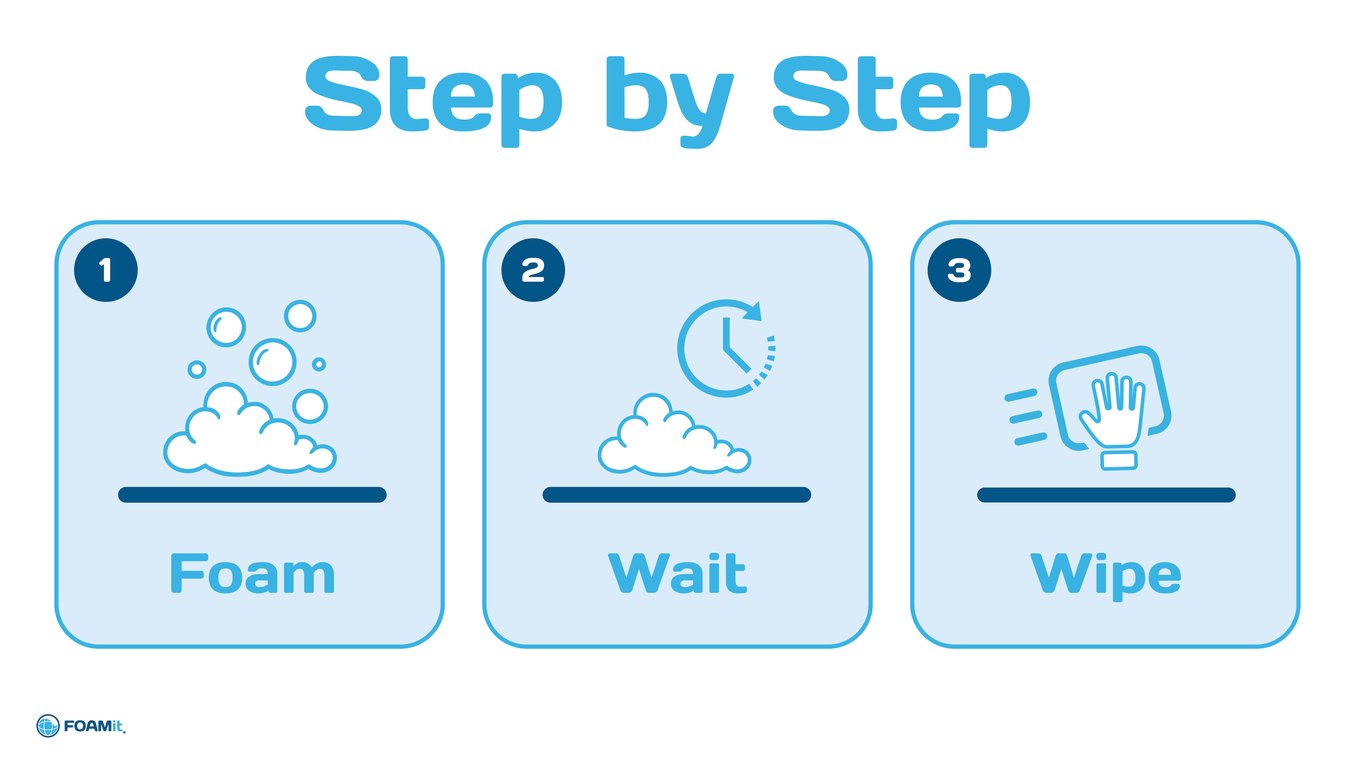
One thing worth checking: depending on your surface type and chemistry, the finish step may be a wipe down or a rinse. Check your label or confirm with your supplier. The foam process is the same either way.
No new SOPs. No retraining. No conversation with your GM about overhauling the cleaning program.
The question worth asking is not whether your team is cleaning. They are. The question is whether the chemistry is getting enough time to finish what it started. Foam is one of the simplest ways to close that gap without touching your workflow.
If you want to dig into what this looks like for your specific operation, contact one of our experts, these are the conversations we love to have.