

Deli counters, seafood cases, and meat departments are among the most difficult environments in a grocery store to keep clean. The surfaces are in constant use. The product is open and often ready to eat.
Keeping these areas sanitized properly takes more than most cleaning setups are built to deliver: a hose here, a spray bottle there, a mop, multiple products pulled from multiple locations.
All of these service areas have a routine. The question is whether that routine adds up to a complete food retail sanitation program, or just the appearance of one.
In a food prep environment, that gap can turn into a problem fast.
Why Food Preparation Environment Demands More Than a Wipe-Down.
A pathogen introduced at a single point on a deli surface can reach multiple food contact surfaces in as little as 10 minutes during normal operations.
The slicer blade. The deli case door handle. The prep table. The employee's gloves.
All within one shift.
Listeria is the pathogen most commonly found in food retail spaces, and for good reason. It survives and grows at cold temperatures. It sticks to stainless steel prep surfaces. Its often found on improperly sanitized deli equipment including slicers, knives, and cutting boards.
Listeria does not just hide in hard-to-reach spots like display case coils, floor-to-wall junctions, drains, and under sinks. It also shows up on surfaces that get cleaned regularly, when the sanitation sequence is not completed properly.
Incomplete sanitation has been directly linked to outbreaks involving ready-to-eat deli products, resulting in recalls, hospitalizations, and in some cases deaths. And it does not only happen in poorly run operations. It happens in counters with protocols, training, and engaged managers.
The gap isn't intent.
It's execution.
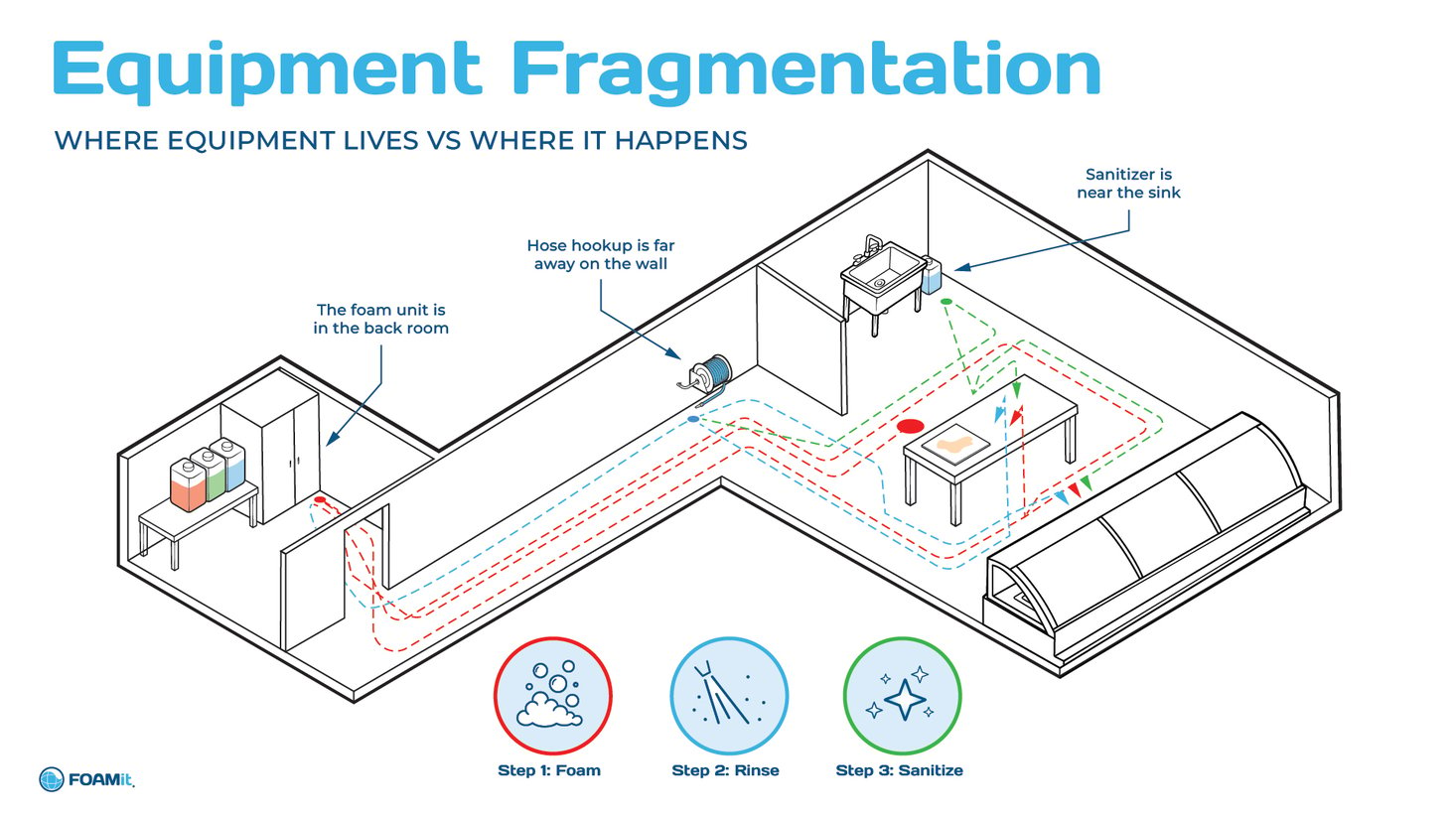
The Real Reason Sanitation Gaps Happen.
Think about what a complete food retail sanitation program actually requires in a typical deli or seafood counter. You need something that foams, something that rinses, and something that sanitizes.
In some operations, one or more of those functions may not even be part of the current setup. In others, all three exist but live in completely different parts of the building. The foam unit is in the back room. The hose hookup is on the wall 40 feet from the seafood case. The sanitizer is a spray bottle near the sink.
Getting through a full program means tracking everything down, bringing it to the counter, and running through the complete sequence before anyone can leave. And in operations that share equipment across multiple service areas, there is another problem: teams dragging the same hose from one zone to another, are also dragging around any contamination that may be on that hose.
In the simplest words: too many components. Not enough time. Something eventually gets skipped.
Why Contact Turnover Increase Sanitation Risks.
Grocery and food retail operations experience some of the highest employee turnover rates of any industry.
When your sanitation program depends on a complicated multi-step process spread across multiple pieces of equipment, training becomes a never-ending battle. Inconsistent cleaning execution across staff is one of the primary drivers of persistent contamination in food retail environments.
A new team member starts. You walk them through the process. Three weeks later, another one starts. The more complex the program is, the more opportunities there are for steps to get missed, skipped, or done out of order.
Success depends not only on using the correct methods, but on consistent and proper execution. When the program is complicated and the team is constantly changing, consistency is the first thing that goes out the window.
So what does it actually take to fix it?
What a Complete Sanitation Program Actually Requires.
The answer is not a better training program. It is a simpler one.
A sanitation program is only as reliable as its least-equipped shift. The shift where someone new is working. The shift where the department lead left early. The shift where the foam unit is not where it was yesterday. Those are not worst-case scenarios. They are common occurrences.
The fix is taking the complicated parts out of the equation.
When the full program is straightforward, it gets completed. When it requires assembling equipment from three different locations, it gets shortened. Not out of negligence. Out of practicality.
Same process. Same equipment. Same result. Every shift, no matter who is on the floor. That is what a reliable sanitation program actually looks like.
The Three Steps That Actually Make a Food Prep Environment Clean.
A complete sanitation cycle has three steps, and each one has a specific job. This is not a framework unique to any one piece of equipment or any one chemical program. It is the sequence the FDA Food Code sets as the standard for food contact surfaces: clean, rinse, sanitize.
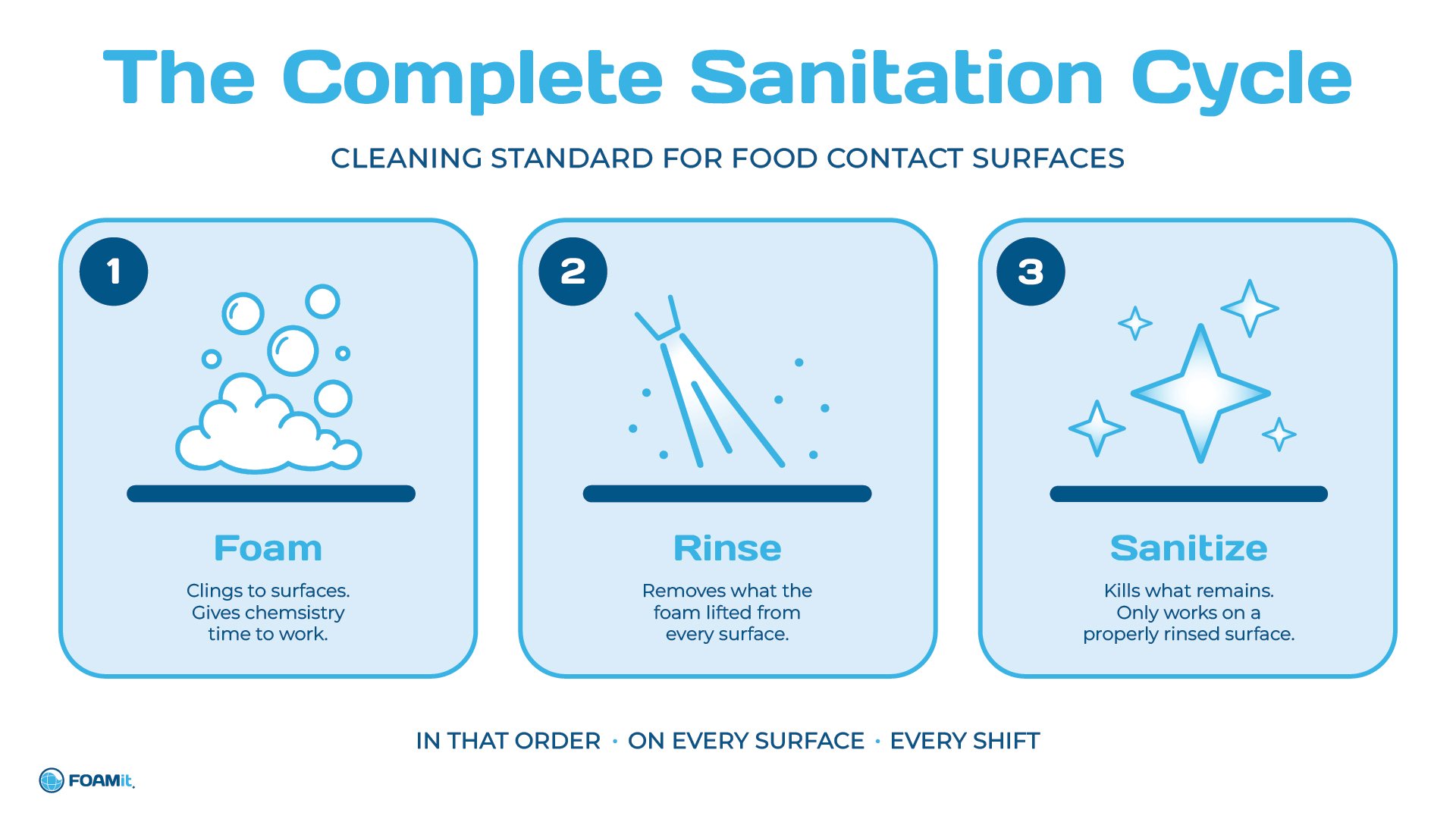
Foam goes on first. It loosens and lifts organic matter from surfaces and gives the chemistry contact time to work. A spray bottle pass does not do this. Foam clings to vertical surfaces, fills crevices, and holds the chemistry in place long enough to act.
Rinse comes second. It removes what the foam lifted. A thorough rinse needs to reach every surface the foam reached, including the ones that are hard to see and easy to skip.
Sanitize finishes the job. Applied in the right concentration on a surface that has been properly foamed and rinsed, it reduces pathogens to a safe level. Applied on a surface that skipped the first two steps, it is fighting through organic matter and cannot do its job effectively.
Three steps. In that order. On every surface that needs it. Every shift.
The sequence is straightforward. Getting it to happen consistently, with whoever is working, at the end of a long shift, is the hard part. Not because the steps are complicated. Because the equipment makes the complete cycle harder than the shortened one.
There Is a Better Way to Build the Program.
The good news is there is a simpler way to get this done.
FOAMit's FRS unit is a battery-powered foam, rinse, and sanitize system built specifically for food retail environments. No outlet required. No air compressor. No hose hookup to hunt for. Everything your team needs to run a complete sanitation cycle lives on one cart that goes wherever the work is.
The whole point is to make the complete cycle the easiest thing your team does at the end of a shift, not the hardest.
If you want to learn more about how the FRS fits into your sanitation program, talk to a FOAMit expert or request a demo.